Rebar Splicing
The plastic ties (or webs) in BuildBlock ICFs hold the two foam panels together and are embedded into the foam. These provide furring strips as well as options to place rebar in the proper position in the wall. Steel rebar reinforcement is required and the plastic webs help to hold it in place. This rebar gives concrete the additional strength needed to resist different types of pressures. It’s the combination of reinforcement and concrete that makes a BuildBlock wall so strong.
For rebar to maintain optimal strength, it must be continuous. Since rebar can’t be made to be continuous for every project, lengths of rebar are cut and overlapped to mimic a continuous bar. This is done in all concrete construction. There are two types of laps in concrete construction, contact, and non-contact laps.
Contact Lap Splice
A contact lap means that the two connecting pieces of rebar touch. Typically in poured concrete, this means that the rebar is tied together to hold it in the proper place before and during the pour. There is no additional strength gained by the rebar tie, it simply keeps it in place. The strength comes from the steel being continuous and this continual line of steel reinforcement is easily and efficiently accomplished with BuildBlock’s web fingers. This method is most common in BuildBlock walls since the webs are designed with locking rebar holders. Even in our smallest blocks, two #5 rebar can be held, lapped correctly, and locked in place. Rebar fingers hold horizontal rebar in place during stacking and pouring. They also allow for rebar to be offset at each course. This creates a vertical chase that will hold vertical rebar in place during the pour.
Non-Contact Lap Splice
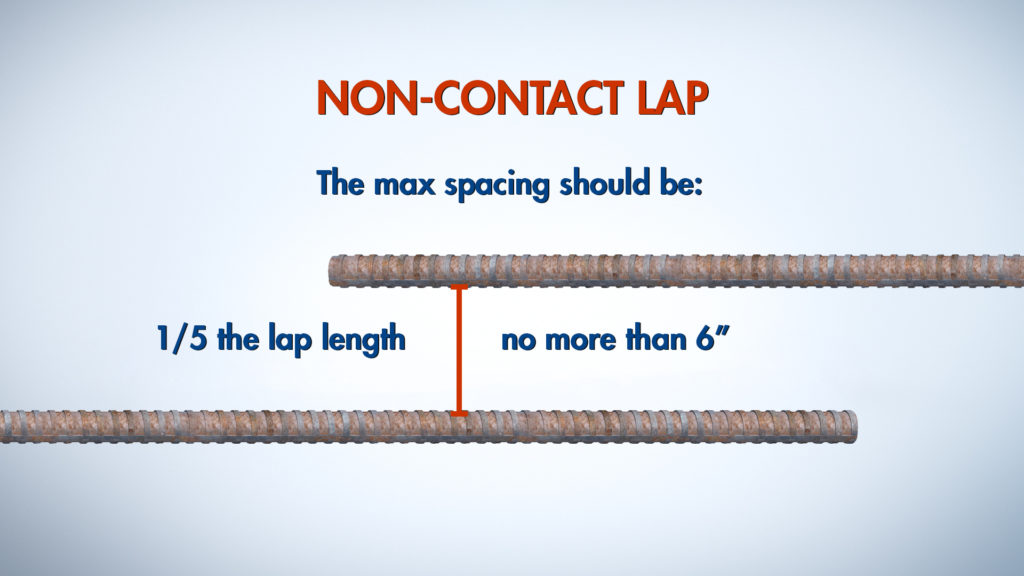
A non-contact lap is when rebar is close but doesn’t actually touch. This method also creates a continual line of steel reinforcement. When using this method, the space between bars should not exceed 1/5th the lap splice length (typically 40 times the bar diameter or 6″, whichever is less).
Calculating Rebar Laps
When calculating for a contact lap splice, use this formula: Contact Lap Splice = 40 × [bar diameter]
- Example: 40 × #5 Rebar (5/8” or .625”) = 25 inches of overlap at each end
- The above result means that rebar must overlap 25” each time it is spliced.
When calculating rebar splices in high seismic zones, use the same formula from above but multiply by 48 instead of 40: High Seismic Contact Lap Splice = 48 × [bar diameter]
- Example: 48 × #5 Rebar (5/8” or .625”) = 30 inches of overlap at each end
- The above result means that rebar must overlap 30” each time it is spliced.
Regardless of its lap or size, rebar must always be embedded at least ¾ inches in concrete.
Be very cautious of too much rebar or loose rebar that could compromise pouring or consolidating concrete.