
Introduction to ICFs
Insulating Concrete Forms (ICFs) are a stay-in-place concrete wall forming system. ICFs are great for use in below and above grade structures for residential, commercial, multifamily, hospitality, institutional, and even pool settings!
This course covers everything about Basic ICF Installation; from form components and assembly, stacking forms, to integrating finishes.
The History of Insulating Concrete Forms
The first ICF design was invented in 1967 by Warner Gregori after pondering the insulative properties of foam used in drink coolers and considering its use in other applications, specifically in construction. Within a year, he converted his foam cooler epiphany into the first real ICF.
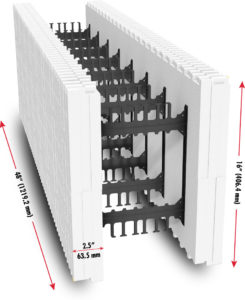
Called “Foam Form,” each block measured 16 inches high by 48 inches long with a tongue-and-groove interlock, metal ties, and a waffle-grid core. The design remained virtually unchanged for the next 15 years. The patent was officially submitted in Canada on March 22, 1966, and the U.S. patent application granted October 24, 1968.
Innovation with Each Iteration
Over the years, the industry standard design of ICFs began to change. As new ICF block designs were released, form manufacturers continued to improve block designs and address various challenges that previous versions (or “generations”) presented.
First Generation ICF Forms
- First generation forms were primarily all EPS foam or required the use of steel ties.
- The concrete in the wall was either a wall or screen design.
- Corners were fabricated using straight forms.
Second Generation ICF Forms
- ICF block connections continue to advance but many forms are still non-reversible.
- ICFs adopt polypropylene plastic ties over steel, which improves thermal performance.
- First generation of factory-molded corner forms are introduced, but many corner designs are short.
Third Generation (Current) ICF Forms
- Introduction of fully reversible blocks.
- Stronger and tighter web spacing.
- Specialty forms introduced (brick ledge, taper top, radius).
- Designed around quick and easy installation (cut lines, molded measuring tape, etc.).
- Addition of reinforced attachment points.
Now that you have an understanding of the history of ICFs, let’s learn about BuildBlock’s ICFs in the next lesson.